The fragility of social order
Leave the World BehindThe fragility of social order is the idea that the routines and protections of ordinary life depend on shared expectations and functioning systems rather than on an unbreakable structure. In the blackout, darkness is not merely an inconvenience: it exposes how much city life, public safety, and even private hospitality rely on people and institutions continuing to do what is expected of them.
Infrastructure and the Appearance of Order
The blackout makes the dependence of urban life on electricity concrete. Ruth observes that dark traffic lights would turn the roads chaotic; the city’s steel and glass, its movement and visibility, all require power. Without it, a place that normally seems solid and self-sufficient becomes vulnerable. The comparison of a powerless city to a flightless bird captures that reversal: a system designed for a particular environment can become helpless when one of its basic conditions disappears.
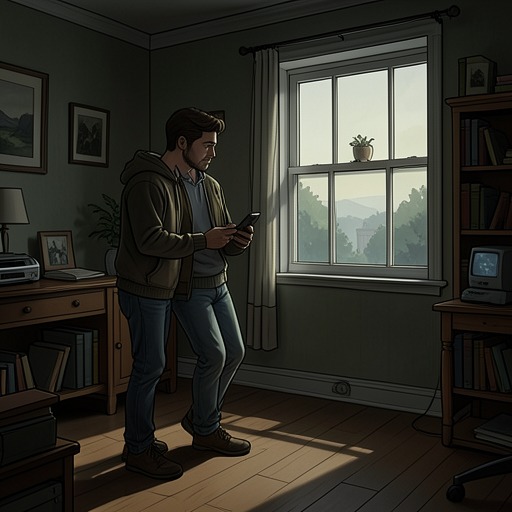
The loss of light also changes the meaning of familiar spaces. Ruth associates a building going dark with something being extinguished, while G. H. discovers that even the basement, a space he had rarely needed, feels different when he must lead the way down its stairs. He turns on lights as he goes and warns Ruth to watch her step. Light, previously taken for granted, has become a practical aid and a sign of safety; darkness makes the absence of protection visible.
The consequences reach beyond the house. The narrative reports failures affecting transportation, communication, and emergency response: a plane is lost amid disruption to air-traffic control, a pipeline spills, and a traffic collision proves fatal when ambulances cannot get through. These are not isolated inconveniences but examples of interdependent systems failing together. The crisis makes clear that the ordinary assurance of rescue depends on networks that can stop functioning without warning.
Agreement, Shelter, and Trust
Ruth formulates the concept most directly when she recognizes that everything holds together through tacit agreement. Order is sustained because people collectively expect it to persist; there is no absolute structure that prevents chaos if those expectations are withdrawn. Her fear is therefore not simply a personal response to an unfamiliar night. It registers the possibility that the common assumptions underlying daily life may no longer be reliable.
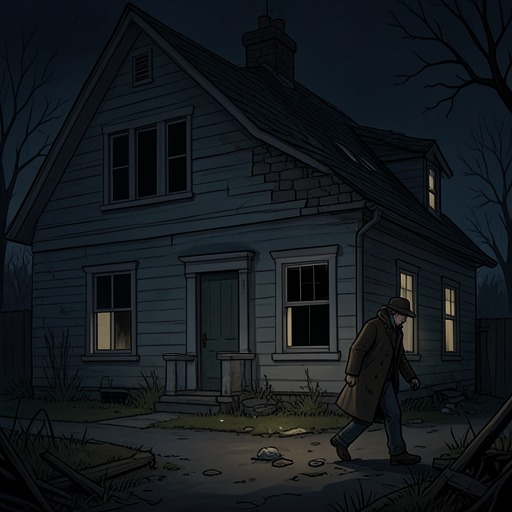
That uncertainty enters the Washingtons’ home with the arrival of Amanda and Clay. G. H. and Ruth explain that they returned because they wanted to be in their own house and safe while they tried to understand events outside. The explanation is reasonable, but Amanda remains unsure whether to trust them; their presence can look like a possible con as readily as a request for shelter. Familiar rules of ownership and hospitality offer no effortless answer. Clay considers whether to let them stay, recognizes his uncertainty about identifying G. H., and nevertheless argues that helping the older couple is the right thing to do. The choice is not made with proof or certainty; it is a decision to act on a limited judgment of another person.
The distinction between paying for a house and owning it becomes part of this negotiation. Ruth emphasizes that it is her home, while G. H. points out that Amanda and Clay have paid to rent it and cannot simply be thrown out. Neither fact settles what the household should do. The home remains a refuge, but its safety depends on accommodating strangers and renegotiating the expectations that normally govern private space.
Unequal Vulnerability and Moral Choice
The crisis does not make everyone equally exposed. Clay’s doubts about recognizing G. H. bring race into a decision he would prefer to treat as practical. He reflects that he is less adept at recognizing Black faces, then weighs that limitation against the possibility of wrongly suspecting a stranger. His reasoning does not resolve the bias or remove the risk; it shows that trust is formed through imperfect perception, and that social judgments can persist even when ordinary rules are under strain.
Later, Clay describes leaving a woman because he did not understand what was happening or what to do. He worries that Rose might be looking for help elsewhere, and the possibility sharpens his sense of what he failed to know. G. H. does not treat the moment as a simple test with a stable moral answer. Instead, he directs Clay and Archie to pay attention, draw a map they can read, and record their actions. In a world where established guidance is unreliable, careful observation and shared records become small, deliberate ways to restore orientation.
Breakdown and the Limits of Knowledge
The narrative expands the household’s uncertainty into a wider emergency. Rose cannot know about reported disruptions and deaths in distant places, while the adults lack a dependable account of what has caused the blackout. The scale of the consequences exceeds what any one person can see. The resulting contrast is stark: quiet in the countryside may feel restful, while quiet in the city signals danger because the systems and activity that usually fill it have gone still.
G. H.’s earlier financial judgment offers another form of warning. He has read a troubling shape in the yield curve and understood it as a portent, but that knowledge has not given him the power to prevent what follows or explain it to others. His insight is consequential yet limited: seeing that something is wrong is not the same as controlling the event or knowing its exact cause. The blackout thus unsettles not only practical routines but confidence in expertise and prediction.
The episode in which George seeks help for Archie makes that loss of confidence immediate. George expects human communion and medical assistance, but Danny refuses to treat the old expectation of mutual aid as sufficient reason to open his door. He argues that George is not thinking clearly. The encounter does not establish that help is impossible everywhere; it shows that the assumption of help is no longer secure. The fragility of social order lies in this gap between a need that remains real and a shared obligation that may no longer be honored.
Significance
Across these situations, the blackout reveals order as both material and social. Electricity, traffic control, communications, and emergency services provide necessary supports, while hospitality, recognition, and cooperation depend on people choosing to sustain them. When the material systems falter, trust has to carry more weight even as fear gives people reasons to withhold it. The household’s decisions consequently become small versions of the larger crisis: whether to admit strangers, whether to seek aid, and how to act when evidence is incomplete.
The idea is not that society disappears the moment a system fails. Rather, familiar protections are exposed as contingent, and each failure makes the next decision harder to ground in precedent. Light can be switched on, a map can be drawn, and shelter can be shared, but none guarantees that the larger order will return. The blackout turns tacit agreement from an invisible condition of daily life into something the characters must notice, test, and attempt to rebuild.